Everything Everything Look Back at Heaven
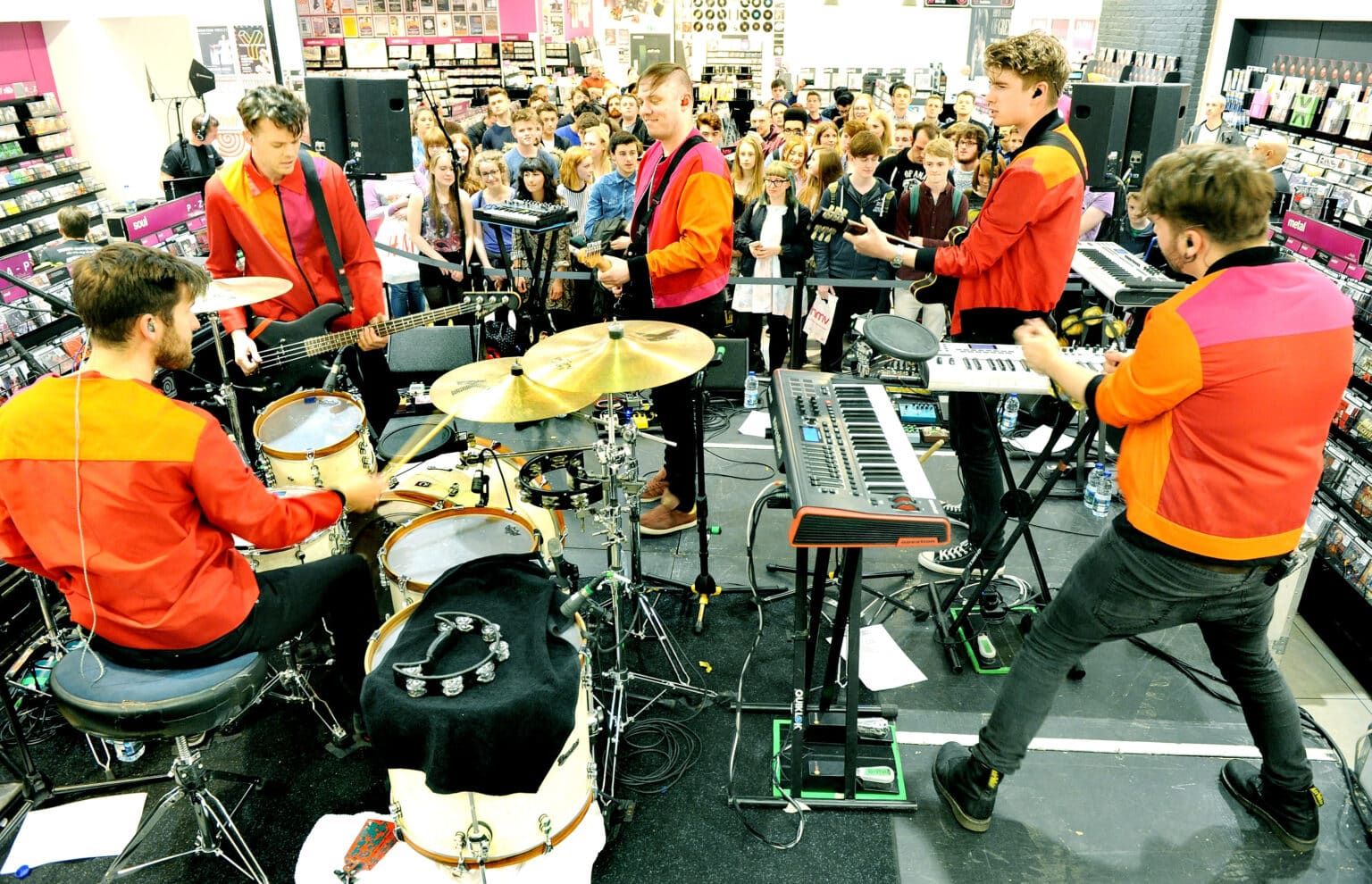
Photo credit: Shirlaine Forrest/WireImage
To promote the “Get to Heaven” 10th Anniversary Tour coming to North America, Siggy Nazimowitz was able to speak with Everything Everything’s Michael Spearman about the album’s celebration, as well as the band’s discography at large.
This interview has been edited for length and clarity.
Siggy Nazimowitz: For any listeners that don’t know of your band, go ahead and introduce yourself and your role in the band.
Michael Spearman: Hey, I’m Mike from the band Everything Everything, I play drums. We’re kind of an art pop band. Some people call us art rock, but we prefer art pop.
You haven’t toured in North America since 2024, and haven’t headlined since 2023. How does it feel to be returning?
We love playing in America. We’ve been over a few times — last time was supporting Keane who we’re quite friendly with, which is a different sort of musical combination for us. But we enjoyed the challenge, and we got to play some really nice, iconic theaters, such as Los Angeles’ The Greek. So that was really fun, and 2023 was our headline tour. We’ve just always had good shows in America. We appreciate the audience’s enthusiasm. To be honest, it’s not the easiest place for us to tour because it’s a big country [laughs]. We’re an English band, and it takes quite a lot of effort and money to go over. But, we always make the effort because we grew up on American culture.
I’m very excited to see the show. I’ve been waiting for some sort of show to be announced since the 10th anniversary shows last year.
It actually took us [laughs]... It’s kind of been 11 years now... we started the touring last year, which was 10 years, but couldn’t quite make it work. We couldn’t fit in America last year, so we thought, ”Well, rather than rush it, we’ll do it properly next year.”
The cover art has always been very striking to me. Before I started listening to your music, I thought, ”Wow, that cover’s really cool.” It was drawn by New Zealand artist Andrew Archer. What was it like working with him?
It was great. We’re a very visual band. Jonathan, our singer who writes the lyrics, is always thinking about the visuals when he’s writing lyrics, singing the songs, and writing the music. And Alex, our guitar player, who’s very involved in the music… I think we were watching something at the record label, a music video that had that kind of... I would describe it as almost like graffiti, but like a skater kind of feel to it. We talked to our designer, Johnny. We said, “Could we find someone who does this kind of style, with the drips and the kind of texture?” He found Andrew, but we didn’t directly talk to Andrew, really. It was all via Johnny Costello, who did all the design in terms of the text and the layout and everything. If you Google, there’s a few options that we didn’t use but still really liked. We just wanted it to feel very vivid, very full of color because the music to us is quite intense and colorful and vivid.
I think the artwork perfectly represents the album. It really is very beautiful and very intense to look at. There’s a lot happening.
Yeah, there’s beauty and a little edge to it, which that album in particular has, you know? The darkness to it. The actual image, it’s like a preacher. We wanted that feeling of almost religious intensity. So we mocked up from some pictures, and then Andrew drew a representation of that.
If you were to make “Get to Heaven” today, how do you think it would turn out compared to how it did turn out?
Michael Spearman: It’s so hard to say, you know? I don’t think albums are always a photograph of time. [“Get to Heaven”] was very much us in that time, so I wouldn’t want to make any changes. I also think it’s a very strong piece of work, even the bonus tracks that aren’t on the main record. It was such an interesting, challenging time for us. We almost wrote a whole record before we wrote [“Get to Heaven”]. We were like, ”Not sure it’s good enough,” and Jonathan had a lot of big feelings at that point. We just decided we were gonna go with it and not question too much because in the UK, we were on the radio a lot. We had some quite big songs (“Arc”) on the radio for us. On BBC Radio 1, “Kemosabe” was the most played song for quite a while (in 2013) and A-listed. In a way, there was a pressure we wanted to keep up. Maybe the pressure got to us a bit at first. We were having trouble being authentic, and when “Get to Heaven” songs started to come through, we kind of knew that we were taking a risk with it. We had Stuart Price come over from Los Angeles to help us finish it, who’d worked with Madonna, Pet Shop Boys, and other artists we aren’t particularly similar to. But he injected a colorfulness, which I think was there, but he brought it out. He basically said, ”Don’t be scared of it.” The reason why I wouldn’t want to change anything now is because we were very bold. It’s harder as you get older to be that bold [laughs]. As you get later in your career, you’re thinking more. You’re referencing stuff you’ve done before, trying not to repeat yourself. And it just becomes hard to be direct in that way, how the early albums are. It is what it is for us at that time, and we’re very proud of it.
I think the lyricism still resonates and holds true today. Especially in the political songs — not that the whole record isn’t political. Songs like “No Reptiles” and “Fortune 500” are still very relevant.
Well, “No Reptiles” is kind of about conspiracy theories. I think the whole record, as you say, has political things running through it. And things about extremism. But “No Reptiles” is kind of about [Jonathan]’s friends who were spending too much time online and starting to believe things that maybe weren’t good for them, or taking things too far. “No Reptiles” is saying the whole David Icke thing about lizard people. [Jonathan] is saying ”Nope, it’s just us.” It’s just us humans with all our good and our bad.
Moving away from “Get to Heaven” and to other albums in your discography. “Raw Data Feel” had usage of generative AI when it was still very new and very rough around the edges. How do you feel about the current state of AI after the fact?
It’s a big question. That stuff gets a bit oversimplified when we talk about “Raw Data Feel.” We had a university professor make an AI engine himself. Commercial versions of [AI] weren’t available. We were interested in what it was going to become. We knew we were dealing with something which was coming down the tracks, and all the arguments that are happening now. Somebody might misinterpret that we’ve written any of the music with AI, which, even if we wanted to, the technology wasn’t there in any proper way. It’s just a few lyrics at the end of [“Raw Data Feel”] and the artwork which use a basic AI system. “Software Greatman” came out of the generative AI we had made. We just liked those words and Jonathan started to write some lyrics around that idea. [The words] don’t necessarily mean anything, but we attached meaning to them. It was more about the process — wondering where the technology is now and where it was going.
I definitely think “Raw Data Feel” is more of a criticism of the technology and all the AI and everything.
It’s a little bit like “Get to Heaven” in that it’s a call to have restraint and to be fair-minded about these things. And not go to extremes. Unfortunately, I think with AI now, the very people who made it are saying it’s going too fast and too far. It’s going to be a rollercoaster. I daresay there are and will be places for AI. The debate about creativity, obviously, we don’t want musicians and artists being replaced by AI. It’s the same in the film industry and all the creative arts. But there will be some things it can do, and some tasks it can make easier as a tool. Where that all sits very much feels in flux in the moment. As with lots of things, in my opinion, we’d probably be better off without it. But it’s here. We can’t do much about that. It’s the inevitable march of human accomplishment. We have to deal with it in a way that suits real people, not just the tech billionaires that can profit from scraping all our data and creativity.
I’ll see you in Boston at Royale Oct. 6! Thank you!