Q&A with Shallowater, a Texas slowcore band
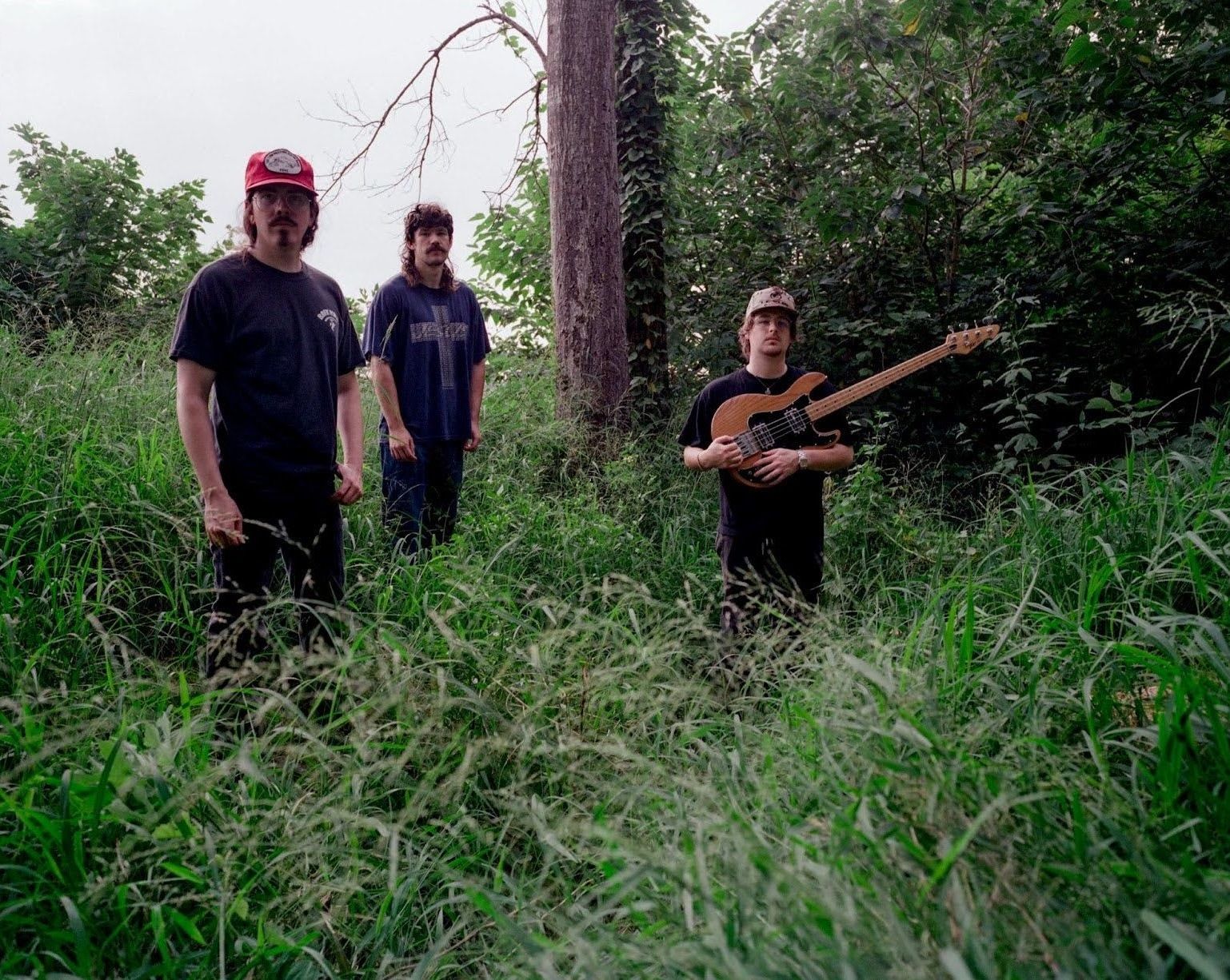
Shallowater, a Texas slowcore band operating out of Houston, is comprised of guitarist Blake Skipper, bassist Tristan Kelly, and drummer Ryan Faulkenberry. WRBB’s Eli Ehrlich and Annabelle Nolan spoke with members Blake and Tristan, where they chatted about George Jones, Asheville NC, counting to four, and more.
This interview has been edited for length and clarity.
Eli Ehrlich: One of my favorite aspects of your music is definitely how you incorporate odd time signatures into your work, but I feel like the uniqueness definitely doesn't end there. You guys have a very quick and strong output that feels quite singular, so I'm wondering for this new record God's Gonna Give You a Million Dollars, what did the process of writing a song look like?
Blake Skipper: The first album was a compilation of a lot of songs we had over a long span of time. We just had to get some songs recorded that had been kicking around, but then all of a sudden we had no more songs. So we had to really kind of just get moving on it, and we had developed a lot, I feel like from learning what it took last time. I think that we were able to just accentuate the things that we liked about the first album and kind of cut out some of the fluff that we didn't. I think it resulted in an objectively more advanced songwriting process and better songs.
Tristan Kelly: Yeah, yeah, I would agree. On God's Gonna Give You a Million Dollars, rather than just a lateral movement of making There's a Well again for anyone that missed it the first time, we wanted it to be a step forward for us. It was awesome—the response we got on There's a Well—but we wanted to impress each other. Every time we came into the practice space, I wanted to show off to the guys something I'd come up with that was different from what we had done before. The odd time signature stuff is kind of like a fine line to walk, because we're not necessarily a math rock band. The beginning of “Sadie” is like a pretty weird time signature—it took a really long time for us all to even really wrap our heads around it, but I think if you're just listening to the song, it doesn't necessarily stand out as really weird. I like can't count to four, so I'll write a riff that I think sounds good and bring it to our drummer, and he'll tell me what it is, and, instead of changing it to 4/4, he'll just run with it and say ‘let's just try and make it work the way it is, cause it sounds good the way it is.’ And that's kind of how it all builds together.
Annabelle Nolan: I think a lot of what you guys are talking about in transitioning from your debut album to your new release is really interesting to us and I'm wondering specifically about your sound. In what ways do you think your sound has shifted between There is a Well and God's Gonna Give You a Million Dollars, and where do you feel like your sound is going from here?
Tristan: Well, I think with There is a Well, it was just like the sound of us all getting to know each other musically. We'd all known each other for a while, but we were just kind of taking a shot in the dark to see if we could make an album. I think with [God’s Gonna Give You] a Million Dollars, it was more thought out. I'm a slow core historian—I just love that genre of music so much, so whenever I was taking the lead on a song, I wanted to avoid the pitfalls of repeating things that have happened in slowcore before. We're not reinventing the wheel of slowcore or anything—no one's ever going to do that—but I wanted to bring something new too; Something that I hadn't necessarily heard before. It's different kinds of, I don't know, ingredients, making the same kind of recipe, you know? It would be harder for us to make something that sounded like Philly shoegaze than it would for us to make West Texas-sounding whatever we make. I think going forward, I want to keep bringing things to the table that impress my two friends that I'm in the band with—just listening to more music and getting inspired and bringing that to the table. I wanna get crazier with time signature stuff, but also, I think of things like All My Love and Lonely Sea.
Blake: I think that one of the big differences between the first album and the second album is the increase of skill that we have. Tristan nor I have formal guitar or music education, so it's all kind of made up, and I think that as we continue to make things up, we're getting better at it. As musicians we're leagues above the first one, and I think we're even better than we were when we made [God’s Gonna Give You] A Million Dollars.
Tristan: Playing these songs off [God’s Gonna Give You] A Million Dollars when we were writing them was the scariest thing in the world. There's so many things that we had never even touched before. There is a Well was a slow album, but compared to [God’s Gonna Give You] A Million Dollars, the songs go by pretty quick. Having to learn how to play that slow was kind of a skill in itself, like maintaining that tempo for nine minutes straight, it was just—yeah. I just feel way more capable.
Eli: Nice. Next, I wanted to ask you guys: If you could sit down to dinner with any artist, living or dead, who would it be and why? And follow up—what's the first question you'd ask them?
Blake: George Jones, and I'd ask him if he wanted a beer.
Tristan: Oh, dude. This is tough. I'd probably like to sit down with David Pajo from Slint. I would love to pick his brain. I would just wanna ask him what music is to him. I feel like so much magic has been taken out of music for me over the past few years, but every time I listen to his work, it's still like magic to me. I just can't wrap my head around what he does or how he approaches songs.
Eli: That’s a great answer. Would you say Slint's a big influence for you guys?
Tristan: I think it was in the beginning. I love Slint, but David Paho's solo work with Papa M and Ariel M is some of my favorite music ever made. The way he uses open tunings is a huge influence on us.
Blake: We've taken some of those tunings and turned them into some songs.
Tristan: Yeah. We owe a lot to his experimentation with guitar.
Annabelle: What country singers did you grow up hearing that have inspired your work or your sounds, even if it was unintentional?
Blake: Once again, George Jones. I grew up in a really small town and kind of hated country, just cause you gotta hate stuff when you're growing up. I didn't really have that much of an appreciation for country until my late teens, and George Jones was a big one for me. Whenever I do karaoke, I always like to do Conway Twitty, cause he's got that higher voice. I think that that's where I'm sitting. I can't really do George Jones stuff, but no one can.
Annabelle: So you sort of discovered country on your own, in your later teen years?
Blake: Yeah, at least it resonating with me. My parents always listened to country so I was exposed to it for sure, but then it was really nice to not be so angsty and be able to appreciate these things. Then, I kind of had this little library in my head of things I had already heard, and I'm like, oh, I like it now.
Tristan: My mom was always listening to Kenny Chesney and George Strait—just like real 90s, early 2000s pop country. Everyone I went to school with that was into country was not somebody I wanted to be friends with. I think I found an appreciation for country even later than Blake did. I didn't really like it until I was probably in my early twenties. George Jones was probably the first true country singer that I really liked, but I got into the kind of country sounds, through Mark Kozelek, palace music, and Songs Ohia.
Eli: That's great. We both definitely had our respective 90s and 2000s alt country phases—big time.
Annabelle: I feel like I'm still in that. I haven't fully transitioned to real country yet, but I'll get there.
Tristan: Yeah, George Jones is the one. That's the one for me.
Blake: Definitely the one. I think the one that got me into country—cause I didn't start off with George Jones—was Hank Williams Senior. That's kind of the beginning of mainstream country—it can get you if you're in a certain head space.
Eli: I'd love to move on and ask you guys if you have a couple favorite albums from 2025, maybe a top three from both of you?
Tristan: Oh man, the Geese record is just undeniable at this point. Also Earl Sweatshirt's newest album.
Blake: I'm going with American Muscle by World's Worst. Probably Geese too. That's easy. And Wednesday's new album is really, really good.
Tristan: American Muscle by World's Worst as well for my third. We got to go on tour with them when that was coming out, and it was so fun to see people discovering that album. Best guys too.
Eli: Sort of a follow up, but who's up next? Maybe from your scene or from other scenes that you've witnessed while on tour—who should we look out for?
Tristan: There's this band from Australia called Twine, I really like. If they ever make it over here to America for a tour, y'all have to go see them. Also, Truck Violence from Montreal. Truck Violence is the best chat pile style metal band I've ever heard.
Annabelle: Was there a particular moment while you were making God's Gonna Give You a Million Dollars, or a song you were writing where you really started understanding it as an album, and it started becoming itself? Or the through line of the different songs became clear?
Blake: We took our time a little bit at first, but then it all kind of started catching up to us. We booked the time at the studio and we didn't have all the songs totally finished. The title track was the last one we finished as a band, and I think that's when it happened. It's my personal favorite on the album, and I think it encapsulates all the ways we’ve gotten better.
Tristan: Yeah, it was definitely like a gun to our head kind of moment, like—we are about to get in the van and go to North Carolina, we need to go record with our dream producer, we have to get the title track done, which we had no concept of, and we just showed up every day until it was done. I think for me, when I first could conceptualize it as a record, was when Blake came in one day for practice and he had “Untitled Cowboy” completely finished. He did not tell us he was working on anything, he just showed up and it was completely done. That’s when I started seeing what this album could be. We recorded it over a year ago at this point. We held onto it for a long time because we wanted it to come out the right way. We kind of all felt a little crazy—it was only us listening to it for so long, and we're like, is this thing even good? But I think we all knew we had made something special. Even if it was not special to anyone else, it was special to us, and we wanted to treat it right. I'm super proud of what we made.
Annabelle: What was it like to record in Asheville and be part of that scene for a bit?
Tristan: We went there at a weird time—I think a month after that huge hurricane hit.
Blake: We were the first ones there recording after they reopened.
Tristan: The town was still recovering. You couldn't use the running water while we were there and the restaurants were serving everything on paper plates. It was a weird time to go visit this place that everyone that pays attention to this kind of music wants to go check out. It was our turn to finally go see Asheville and do our record out there, and it felt almost like something we shouldn't be there for. So many people went through this horrible tragedy and we're just coming in to record a record. Because of that, we didn't really get to be like a part of the scene while we were there, we were just kind of at the studio for that week.
Blake: On top of that though, Alex Ferrar is amazing to work with, and also a really good guy. He made the album sound way better than I imagined it in my head.
Tristan: Without Drop of Sun, this record wouldn't be what it is.
Blake: Also a pedal steel guy. He's quite a character.
Tristan: The pedal steel was all done in like 22 hours—it was insane. He had never even heard the songs before. I'd never seen anybody work like that. And we got to record the whole thing live, which was just an amazing experience. I didn't think it was possible to do that. I'll never forget it.
Eli: All right, I think we've got time for one more question. I'd love to ask about collaborators. I know you guys are friends with Hayden Pedigo—and it was great to hear him on your newest record—and I know you also collabed with Jordan Roth, so I was wondering if you guys had any other collaborations that you were gearing up for, or doing, or maybe hoping to do in the near future?
Tristan: Yeah, we're working on something, with someone. I don't wanna jinx anything, but yeah, There's gonna be some pretty cool collaborations coming this year—I think if everything works out, a lot of them. It's fun to work with people. I don't know why people don't do it more often. Working with Hayden—we have just been friends for the longest time, and we've always wanted to do a song together and it just finally worked out. He was there for when we formed the band out in West Texas, and he was always there just popping in. We jammed with him sometimes before he got signed to his record label, so music to us has always kind of been this collaborative thing. We've had like a fourth member play with us in so many different ways. It's been so many different people coming up on stage and playing either one show or a string of shows with us, and you never know what's gonna happen. If you're writing music, it takes you out of yourself for a little bit, and you get a new idea that you wouldn't be able to come up with yourself.
Eli: Awesome. Well, we can go off the record here, but after saying thank you so much for talking with us.
Tristan: Dude, thank you so much. This was super cool. So y'all have been playing our music on the radio out in Boston?
Eli: Big time.
Annabelle: I've been trying to put all my friends on.
Tristan: Hell yeah. Y'all have a fucking great day.
Blake: Really appreciate y’all.