Let’s Talk DIY: Yardwork Productions and Rat 3
Summer, without a doubt, is festival season, with giants like Lollapalooza and Bonnaroo dominating the social spheres. These festivals were once a pillar of counter-culture, but are now run by mega-corporations– But what if I told you the heart of DIY remains and has fests of its own?
Rat****** Music Fest 3 takes place this August 22nd and 23rd in Somerville, MA. The fest celebrates collective care through music, art, and gathering with a line up of 14 local and regional bands, 15+ vendors, and 5+ community advocacy organizations. This year's headliner is Lady Lamb from Maine, an indie artist with a cult following who has previously headlined at The Sinclair and Arts at the Armory. You can get your tickets now for this year's fest at yardworkproductions.com/shop.
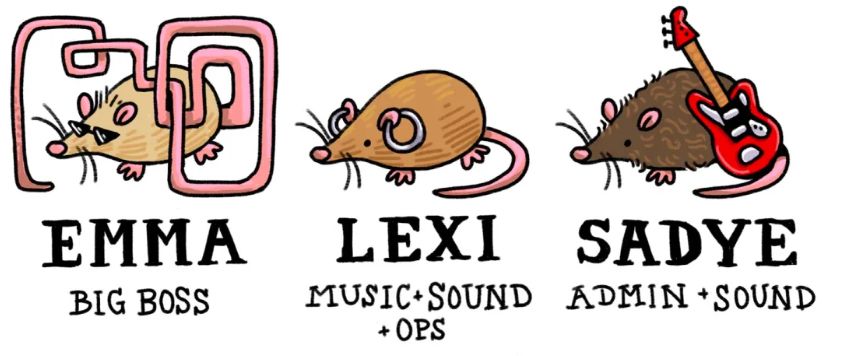
I had the opportunity to sit down with Emma Caviness, Lexi Howard, and Sadye Bobbette of Yardwork Productions to talk about the upcoming fest and discuss what goes into DIY event planning, how to become involved in your local scene, and the things Yardwork does to give back to the community.
This interview has been edited for length and clarity.
How did Rat****** begin?
Emma: I’m not a musician, but I have a lot of energy and love to get people together. I feel like the art form that has the most energy behind it is music– live music, particularly DIY. So I wanted to get to know my community through that lens, and I had a beautiful park-front backyard in Somerville where I started hosting concerts throughout the summer of 2022. People were coming out, the neighbors were partying with us- they’d pass hot dogs over the chainlink fence and it was super cute. And it felt really good.
Why Rats?
Emma: We call it Rat because right around that time there was the Green Line extension, so all the rats that were living under that undeveloped area were being relocated to these fancy gentrified neighborhoods in Somerville. So during the day, they look like these gentrified, fancy neighborhoods, but at night there are rats living under these amazing playgrounds. And somebody in that park drew this big, ugly looking rat and wrote, “This is rat country”. So that rat has become our mascot. We use that same drawing for all of our branding.
Rats have a big community aspect to them– what sort of community and people are you looking to come to the fest and join you in this DIY space?
Sadye: Yeah, I think the whole idea of the Rat Music Festival and this is rat country is that we all deserve to live here. Nobody is disposable. Not even rats.
Emma: We also, for the record, take a pretty metaphoric approach to what rats are doing with our fest.
Sadye: We embrace this scrappiness of the rat through this fest. We're putting this thing together in a very DIY, scrappy way– Encouraging everybody to attend and everybody not only to be there, but to help us create what they want the fest to be. So we have a lot of elements that are like community created, community involved. All the rats are welcome.
Emma: This scrappiness, like Sadye said, the creativity, the resilience, the sort of like parts of ourselves that maybe we shove away or call disgusting. All of that, like exiled stuff that we hide from ourselves that you wouldn't always feel welcome to bring out– We want to welcome all of that. So there's a lot there and a lot of it comes back to a rat.
Sayde and Lexi, how did you guys get involved with Yardwork Productions?
Sayde: I got involved at the beginning of last summer after meeting Emma. I’m in a band called Otis Shanty, and I had heard about this festival for a couple of years, and then I met Emma at Porch Fest. It started with wanting to play with my band, and then through the summer, I got closer with Emma and realized that what her and Corey were doing was something that I have always wanted to be a part of. I lingered in the background and shadowed for a bit, and then I found ways that I could really help. I had an absolute blast last year and then after Rat 2, Emma decided she kind of wanted to open it up to have more people. So I'm part of the core team now.
Lexi: Okay. So this is a modern love story, I guess. A couple of years ago, I really started getting into the DIY scene and wanted to get more involved with the scene. I saw that Emma and Corey were throwing this fest on Instagram, so I reached out and was like, yo, can I get involved? I did some photos for the first one, and then last year, I saw they were running the Sound Guy* training. I did that, and then I worked at Fest and made some awesome friends, who I got closer to in the past year. Then this year I got to join the core organizing group, and help organize the fest. I think that's one thing we like to say is that
If you want to get involved, there is a way to get involved. Go on our website, send us an email, send us a dm– There's something for you.
You guys mentioned trainings and having these accessible ways to get involved– can you expand on what exactly you offer?
Emma: Yeah, we have a volunteer form through our website and Instagram and whatnot. We like to treat our volunteers real nice!
Sadye: There’s also art builds that create the world that is the fest every year– a visual world. Everything at the fest is created by the people who come to these art builds. There's some really incredible art that's made. And it is like it is so much more than we could do as a team of eight people. It's been really cool to just gather everyone's fabric scraps and old clothing and random old craft supplies that they have and bring them over and make signage, make big rats, make whatever you kind of want to make. It's awesome. Shout out David from the Loov. He's been letting us use his space this summer to host these art builds, huge capacity room.
Lexi: Should we talk a little more about the sound trainings?
Sound is always hard to find. How did you get people to start sound training and encourage that?
Emma: Well, Sayde knows everything because she plays like six instruments in her band and has tons of experience, so it's really nice when you have experienced people in the room to start. That is the basis that you build from.
Sadye: Yes, and– It's helpful to have the background of knowledge of being in a band but, I've always been interested in learning more about running shows. I think a main thing that a lot of us have experienced, a lot of musicians, a lot of people in the music scene is the sound guy, typically a middle aged, cis male who really has their way of doing things. I do think an experience that a lot of people have is feeling spoken down to, feeling like their sound is ending up the way that the sound guy wants it and not the way that they want it to end up.
Sadye: As one of our sound instructors has said to us– it is a service industry job, your job is to make a really awesome experience for the artist and make their music sound the way they want it to sound, and historically, women and gender queer people have not been able to access this part of the industry. It is gatekept by a certain demographic of men. We thought it would be really cool to open up the opportunity to learn, in an accessible way for people that don't really fall into the typical category that the sound guy is.
Sadye: Last year we started hosting these, you know, Sound Guy* trainings. We say it's for women and genderqueer people, but it's really for whoever. We encourage people who maybe have been a little bit more marginalized in the music industry to come out– And it's a free opportunity to learn. You don't have to know anything. Just learn the basics of like, how to wrap a cable. What's a quarter inch? How do you set up a stage? What is a PA? And then this year, we're really looking forward to continuing the series in the fall by offering some 201 and maybe some 301, classes after the fest. And we've been working with Cade and Max of Warehouse XI, who have been teaching.
Emma: It's pretty feminist rage based, but it's also just about democratizing technical information that ends up being a big barrier to getting involved. We want to make sure that people can tap in immediately and do something cool while making sure we’re not hitting them with the firehose of what it takes to put something on before they're ready. You got to make it worth their time. We're not getting paid right now to do this fest, and so you really have to focus on balance. Checking in and being like okay, do I have enough of a relationship with these people I'm working with to make sure that when I need help, I know how to ask for it? And that actually starts tying into some like mutual aid organizing principles. We're not going to claim that term, but if there was a Bible for Rat******, Mutual Aid by Dean Spade right now is definitely it.
Sadye: It's a really awesome, awesome book if you guys don't know it.
Let’s talk about this lineup– how did you get so many local legends and book a pretty big artist like Lady Lamb?
Emma: Well, first of all, you start with whoever is willing and willingness goes a long way. It's one thing to put together a great show; it's another thing to want to do it again. And I've always, like, been really tuned into that because it it takes a lot of energy, so making sure that you are tapping into that willingness is how we've gotten to a place where we are able to reach for bigger artists. It is a gift to be able to have a dream list and call up bands and have them say yes. I don't think we'll ever want to move away from willingness. I think that it's super important to work with bands that are willing, not just bands that are buzzy or are pulling people out. There's something really fun about the spirit of the willingness.
Emma: We had one of our team members, Lizzie, she said, you guys, “What if we get Lady Lamb, let's get Lady Lamb.” And we were all like, whoa…
And look at what happened!
Emma: Yeah it did!
Lexi: I think what Lizzie really saw was, as you said, Emma, the willingness, the ethos that lined up with what we're about. We felt like there was a fit there and reached out. And she was interested.
Emma: Conveniently right around the time that we were talking booking, she was posting all this stuff about feeling really sick of mainstream music, the music industry at large, and wanting to go where people were making their own scenes happen. We were like, that's us.
As a college radio station, a lot of our members seek out these communities that value the youth’s political voice. How can people find these DIY spaces and join this community?
Lexi: One of the things that Emma shared early on, when we were coming together this year for the first time, that really stuck with me is no one is too big– no dream is too big, essentially. I think that really pumped me up to get motivated and reach out to folks that I was excited about. I think that's kind of how we pulled together the venue last year.
Emma: Yeah, actually there are preexisting venues out there that you can find just by asking around or going on Instagram and falling down– how you would find a tattoo artist like you could do the same thing, but with the DIY venues and just click through every name. Or you could make your own– That is also way more of an option than people would believe, but it's also really hard. It means that in addition to, like, loving a good party, you kind of have to be down to do admin work, so there's a balance to strike there. With enough planning in advance, you can make cool stuff happen.
You guys are doing a great job of hitting different niches– you have something for everyone. You guys are doing this beautiful blend of what people are into you and what represents the Somerville/Boston/Allston DIY community.
Sadye: Thanks for saying that. I think we'd rather kind of paint a picture of what northeast DIY music sounds like right now in 2026 rather than a genre specific or cohesive line up
Emma: If people don't listen to Lady Lamb, I would like to give my little Lady Lamb shoutout– She is doing something really cool and politically speaking, she is just going for it, and it's something I take a lot of inspiration from with organizing a music fest like this. We're really trying not to compromise our values for our desire to have fun and make cool art. When I was talking earlier about how we got started during a time that there's like a ton of gentrification happening and a bit of a housing crisis, we were also like bringing out Community Action Agency of Somerville and a few other groups that are doing housing justice work, to sign petitions to keep our neighbors in their neighborhood. You can escape without actually having to escape what you believe in.
Emma: Last year we had Somerville for Palestine come on stage and talk a little bit about the work they've been doing and had someone sing an original protest song. I do think that Lady Lamb brings up a lot of those feelings. She is such a staunch advocate for human rights against the fricken crap show of what goes on in the world right now. So in a way, it makes DIY even more important, because the connection is there. If we learn how to organize ourselves for something awesome and fun, we will have that same muscle to organize for things that are a little scarier and a little bigger. So it's also practice.
Absolutely, I think the most important thing that comes out of DIY is the power in the community and the idea of you have a voice and you're stronger kind of together.
Sadye: We're trying out something new this year. It's called the RATS Ticket, stands for a Radical Approach To Solidarity, and it allows you to get a very discounted ticket if you are doing community work. By engaging in really anything that you view as helpful to your community, we're going to snail mail you a little ticket. You can write down your five community events that you've contributed to, and that's your entry to the fest. We're not a FLOF, so no one is turned away for lack of funds. On top of that, there's a way for you to come if you want to be there. If you want to volunteer and come to the fest for free, we'd love to have you. As long as you're willing to help us out. That's all we ask.
Emma: One more thing on the solidarity ticket, we're not necessarily asking you to go out of your way and do more than what you already do. The whole point is if we are trying to bring the world that we want into existence, we want to value the work that's already happening that's bringing that world into existence. So our RATS ticket is a way where we're trying to value those potlucks, those house shows (assuming they're consent based), phone banking, going to protests– When you're volunteering for other stuff that's aligned with our values, we want you to see that work as value towards your tickets.
If you’re looking to get involved with Rat Music Fest or your local community…
follow Yardwork Productions on Instagram: @yardwordproductions
follow WRBB on Instagram: @wrbbradio
and come to WRBB events! There’s no better way to get into music and shows in Boston than to come to shows and meet people to go to more with!!