Q&A: Racing Mount Pleasant
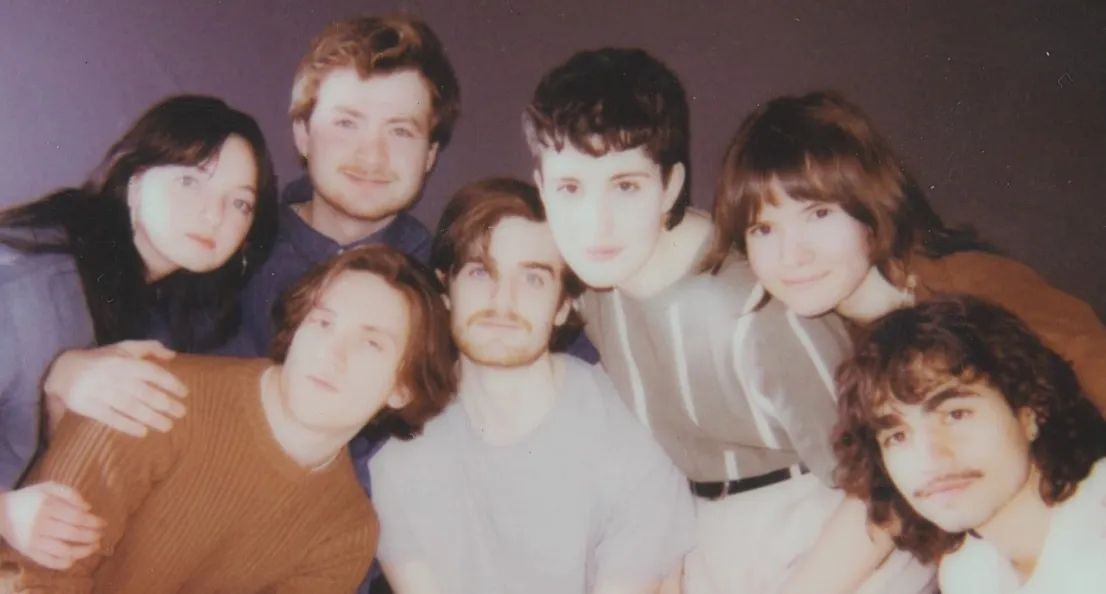
Racing Mount Pleasant (RMP), an indie folk band, was formed by seven University of Michigan alums during their time in college together. The band’s expansive music and diverse instrumental range gives the group a truly unique sound. RMP will set out on a U.S. tour in May 2026.
WRBB’s Will Pettit (DJ Will) interviewed RMP’s Callum Roberts and Kaysen Chown after their show at The Sinclair on their January 2026 U.S. tour. This interview has been edited for length and clarity.
Will Pettit: Callum, Connor, and Sam met on an off chance at college orientation. Does that chance meeting make you guys value spontaneity when you’re writing your music?
Callum Roberts: Me, Connor, and Sam meeting up was something that didn't really make a lot of sense in that it happened [despite the fact] we were all studying very different things. I went into school for classical music and Connor went into school for jazz and Sam was going to become a recording engineer, which is really just a code word for saying he wanted to be in a band. I think the fact that we all wanted very different things from music led to this idea that we would try to be spontaneous or creative with the way that we would write.
Kaysen Chown: There's an equal blend of improvisation in our music. Sometimes that's how we write the parts, but then there's also this equal part of perfectionism and hyper-attention to detail, trying the same things over and over again and changing one little variation. So in that way, it's not spontaneous, but there's a mix of both.
Part of your writing process focuses on repetition, but that repetition is used to bring out something new; the next step. Can you explain that?
Kaysen: Totally. You listen to Your New Place and there's these repeating figures, like four times or eight bars. But a lot of our music is built on trying to find a climax, how we can get there and how we can slowly evolve parts or slowly add in instruments. We have a plethora of instruments at our disposal. There’s seven of us, and we all play a bunch of instruments, so it's kind of easy, in that way, to just develop a song instrumentally — adding a new figure, new instrumental line or anything like that.
Callum: When we try to write the horn parts [and] violin too, a lot of it is that we will play the same part of the music along for a while. I think there's typically a way that you will write like default parts. Default horn parts can come the second or third time you pull through something, as soon as you know the chords, and you know roughly who is going to be where. I think that we don't really try to write from an analytical perspective. We repeat something until something creative is heard by somebody. Then, we can use that to fill in the rest, as opposed to trying to push for something complicated, and then settling into something else.
Does being a relatively large group and having a lot of instruments help you hone in on these specific things or specific feelings that you want a song to approach?
Kaysen: We can be more particular because we have all these instruments at our disposal. We have more of a decision power in like, “Okay, what do we need in this part of the song?” We can pull from our little bag of tricks like, “Okay, let's add a trumpet line there or, let's add like, fucking saxophone effects and whatnot.” We just have a lot of tools in our back pocket, so we can be specific with what we want to hear from a specific part.
Do you think there's ever an instance where you prefer simplicity in the music?
Kaysen: Oh my god, yeah. Constantly we're toeing the line of adding things just for the sake of adding things. How do we find that perfect balance?
Callum: We want all of the arrangements to be as interesting as possible, before they become contrived. We're trying to walk the tightrope of what's interesting to play, or…
Kaysen: …what's coming out of my ego.
Callum: I don't want to play something just because it makes me feel cool to play. I want to write a cool part that sounds good.
Is it sometimes hard to navigate trying to balance your own musical egos in such a big group?
Kaysen: I mean, you're talking to the auxiliary players of the band. We find little ways to make what's already there sound better with what we add to it.
Callum: It can be fragile. There are some songs where, my trumpet part, I hate playing it, because it makes me feel like I'm not showing off enough. But I 100% believe it's also the best thing to go on stage and play.
Kaysen: We can’t all be strikers on the field, you know what I’m saying?
Is it that way in the songwriting process, too?
Kaysen: Definitely, we break up and we have our own moments. Callum and I wrote the bridge to “Shallows” on the album, and that was a really great moment. You can hear our musicianship there, [and] that feels really great. But, sometimes you take a step back and let someone else's
voice come through.
Do you think there’s a theme of intermingling within the different groups within the band, like the horns together or the rhythm section or the guitars?
Kaysen: Yeah, we have sectional [practices], which is lame.
Callum: It’s not the most rock and roll thing in the world.
Kaysen: We’re music students at heart.
All seven members of Racing Mount Pleasant. Callum (left) and Kaysen (right) wear matching burnt orange. Photo Credit: Auxiliary Memory