WRBB x The Magnolia Electric Co.’s Jason Groth
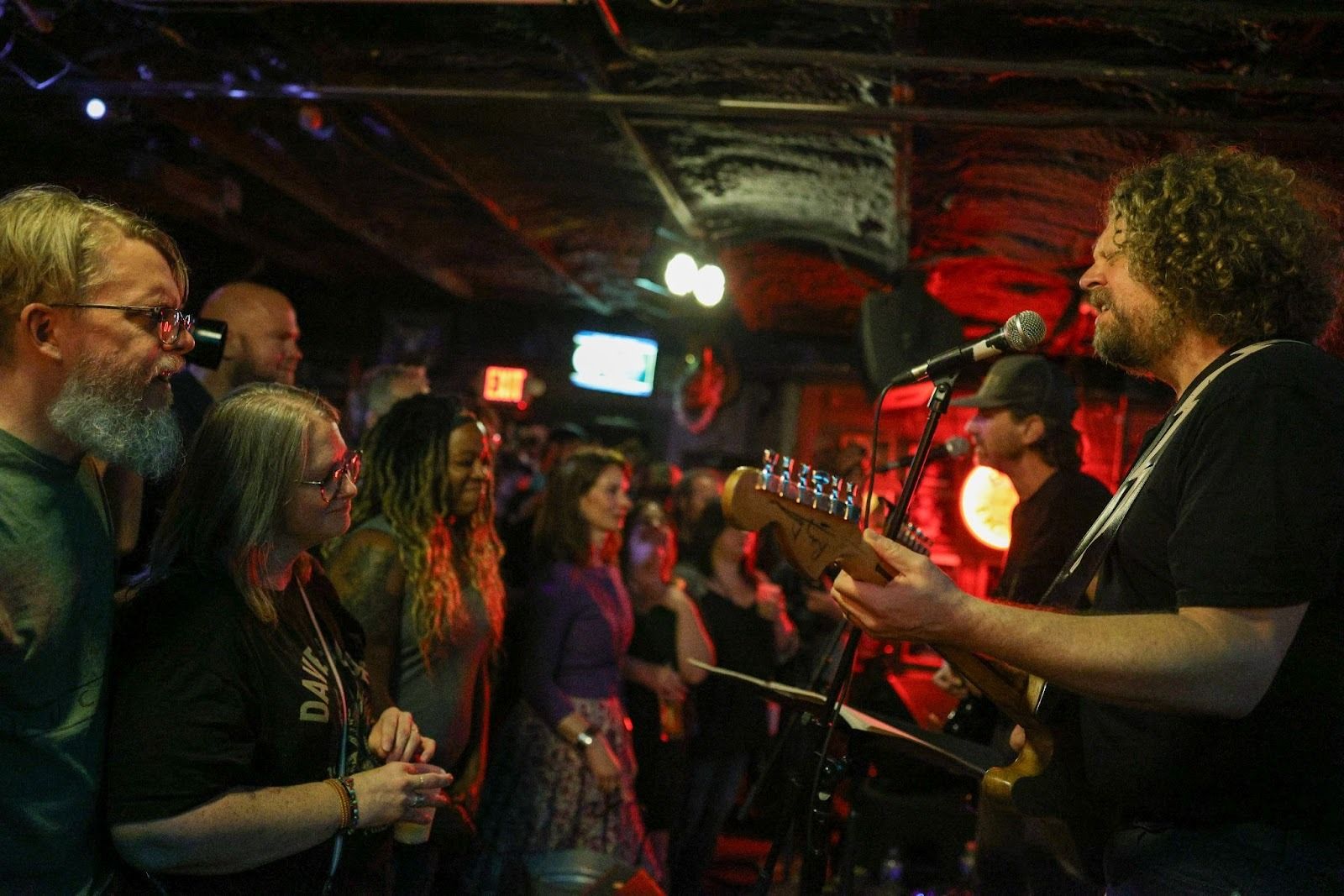
Photo Credit: Alex Jackson
Magnolia Electric Co. is one of late singer-songwriter Jason Molina’s projects, recently resumed by its surviving members — with the addition of singer-songwriter Will Johnson as frontman. Instead of picking up where they left off in the early 2010s, the band’s focus has shifted to commemorating the life and legacy of Jason Molina. Through stories upon stories about the history of Jason’s solo project, Songs: Ohia, and Magnolia Electric Co., as well as performing Jason’s songs as true to form as they can be, the band plays as a powerful tribute act. Magnolia Electric Co. has brought together generations of fans and even made some new ones.
Minutes before Magnolia Electric Co’s concert began in Amherst, Mass. on April 11th, 2026, WRBB’s Media Director Eli Ehrlich (DJ Surprise) and Josiah Lamirand (DJ Dusty Boots) spoke with guitarist Jason Groth about the group’s influence, memories, identity, and legacy.
This interview has been edited for length and clarity
Eli Ehrlich: Have you noticed a resurgence in Songs: Ohia and the Magnolia Electric Co.'s music during recent years, and how do you feel about that?
Jason Groth: We were just talking about that in the band today. Last night in DC was likely the biggest show — the biggest headlining non-music festival, non-opening for a bigger band show — that I think any one of us have ever played, including Molina. We’re seeing multiple generations of people together. There was a grandfather, father and son; three generations of folks who all loved the music. I feel really good about it.
I met Jason Molina in 1997 and was a fan of his music before I was asked to be in Songs: Ohia. I knew it was timeless then, and didn't have any doubt that it was something really special. When I became a full-fledged member in 2002 through the end of our touring days and through Jason's death, there were certain pockets of folks that would talk about how incredible of a songwriter Jason was. We found ourselves aligned with country bands, and Jason never felt like he was part of any of it. He felt like he was aligned with people like Will Oldham and Bill Callahan, and the folks at the vanguard of what is now considered to be that era that has influenced so many bands.
Josiah Lamirand: I think aside from the fans, you guys inspired a whole upcoming generation of musicians just from that sound of blending different things that were rising in the ‘90s and the early 2000s.
Jason: Well, thanks for saying that. I think that we were just all products of a similar record collection, and we weren't afraid to play things that sounded like classic rock or had country elements or even verged on metal. I think labels were really important to people. They wanted to group people into the Strokes thing and the White Stripes thing happening. There were also singer-songwriter things happening and big bands doing emotional music. I don't think we fit nicely into any of those. We kind of did stuff that had elements of all those things.
I feel really good that we stuck to Jason’s vision for his songs. He trusted us. We were his bandmates for so long. He never told us what we had to do, we all just did it as a group. We became almost psychically connected in a way. Resuming the band, I think we felt less bad about trying to make ourselves out to be anything more than just this band that lived together in vans for a long time. Our singer is gone, but his songs aren't.
Josiah: You were talking about some of the sounds that we’re hearing today that came out of things you were all listening to, do you have any just from the top of your mind?
Jason: I think I became fully Neil Young’ed in 2001. I had loved Tonight's the Night. It was the only Neil Young record I had and I bought it in 1996. I listened to it endlessly, but I hadn't really moved on from that. Maybe I'd read in a list that nothing was better than that. Then a friend of mine found out I was able to digitize records and she gave me a collection of stuff that she wanted to get on CD so she could listen in her car. One of those records was On the Beach and and I remember that made me feel like I was allowed to play music. That was around when I heard Didn't It Rain and I was like, “Oh my God, he must have been listening to On the Beach too.”
I felt this connection and I would see Jason every now and again. He lived in Chicago at the time, but I'd run into him at shows. I'd go see him play or my bands would play with him and that was when the Neil Young thing was a big deal. That's when Sweetheart of the Rodeo entered my life. That's when John Prine entered my life. But this is on top of all those ‘90s indie bands or bands like Slint and Codeine. I know there's those memes going around saying, “this all started with Neil Young” and I firmly believe it. It's all in there. Everything that we like is in there.
Josiah: We've been calling it the lineage.
Jason: Molina used to refer to his ‘90s music as an indie rock jail of some sort. I think he was looking to do things. I was in a political punk band and a Minutemen style band that he really liked and a psychedelic band that he was into. We just all liked each other's stuff, but it was clear that we were all coming from the same place, kind of referentially. We were also really into corny Midwestern stuff. Jason, when he met me, found that I could talk about Bob Seger as much as I could talk about Pavement or Cat Power or something. It was partially because we just grew up immersed in classics.
When I was growing up, it didn’t seem that anybody from the Midwest was doing anything that made me feel the way that Jake Lenderman described. You know, finding that Pavement record. It was just stuff that was around us.
Eli: Are there any bands that you are interested in who you think are going to leave an impression on a lot of newer artists?
Jason: Thinking about what you just said about who we influenced, I didn't notice when I saw Wednesday for the first time in 2019 that we had an influence on them. What I heard was a stew of influences that reminded me of the stew of influences that I had felt. It's awesome if there was any influence but what inspired me about seeing them and then seeing them get bigger and bigger was that they also seem to be really true to what it is they want to do. They're already super influential. There's no doubt that will continue.
I saw MJ Lenderman in a basement in Raleigh at some point and at clubs. There's no doubt in my mind that these good North Carolina bands are not only writing great songs, but they're also doing such a great job of encouraging each other. I've been a huge fan for so long of Wednesday and MJ Lenderman, so getting to know Jake and playing with him in Asheville is awesome. I have seen them as they grow up a little at least into their twenties. There's a group called Tombstone Poetry that I think is great, and they have their hands in all of the things that Asheville is doing right now. It gets a little emo sometimes, it gets a little like alt country sometimes, it gets a little screamy sometimes. All the musicians are excellent, and they're just such nice people. One of my favorite records from last year is from a guy called Tanner York, also from Asheville, who played a show with our other band, The Coke Dares. Mark, Pete and I from that band are in Magnolia. Jason loved the Coke Dares. Maybe that's the reason we're in Magnolia. We played a show with Tanner York the day Brian Wilson died and he did a cover of “That's Not Me Alone” and I was like, oh my God, like I’ve wanted to do that since I was 21.
Asheville is this hotbed of people who are coming from all these angles like we can have all of our influences. I think they end up coming out in country kinds of ways because it feels really good. That music's been around for a while because it feels really natural to play it, so all the hardcore people I know who've moved into country bands, it's not because they're trying to make money. I think it's because it's just always been part of what they're doing.
Eli: I have a couple questions about resuming live stuff. First off, do you have a most memorable Magnolia Electric Co. or Songs: Ohia concert that you guys have played?
Jason: Good question. There were so many. I'll go era by era. In the 2002 to mid 2003 era, probably the show that became Trials & Errors. That was our 10th show. Trials & errors, that show was great. The show the next night, which I wish we would have recorded, is the same setlist. I'm glad we got that one in Brussels, but this one in Dixmoya, Belgium was fantastic. Imagine Trials and Errors and it's fewer mistakes. Maybe a little shorter, maybe louder–that one for sure.
Starting at the end of 2003 when Jason changed the name of the band and didn't really tell any of us he was doing it, there was a show with Jenny Benford who we’re playing with tonight. She was on a lot of the later songs. Her voice is all over Didn't It Rain. We're gonna play her song that's on What Comes After the Blues tonight, which we never get to do, so it's really cool that she's here.
The show we played with her at Schubas in Chicago the day before we recorded What Comes after the Blues, which is probably on the Internet Archive or something, I remember that being a spectacularly good show. We had spent a couple of weeks figuring out how to be this bigger band, and that show with Jenny really, really made it for me. Mike Brenner, who was on the Magnolia Electric Co. record, joined us. Then it became bigger, and I think we finally figured it out.
In 2006, we did a tour with Destroyer, right after they put out Rubies. That might be my favorite rock tour of all time. There was a show — I think we were playing really well that year — and it was Destroyer and Mates of State playing in this big room. Somebody dared and paid our keyboard player Mikey to, during the Mates of State show, go out with his pants around his ankles, bend over in front of the crowd of 1500 people, pick up a bottle of whiskey, drink it fully unpantsed, and then walk off stage. I feel like that show was fine, but that memory of being with Dan Bejar and recording Mikey doing this and then running away giggling, I just can't believe we pulled that off. I wish the video still existed because it's pretty funny. Pitchfork even wrote about it at some point, saying “What are they doing? Why is Magnolia pranking Mates of State?”
Then in '09, the set we played at Primavera Sound in Barcelona was pretty remarkable because it had been a while since Jason had gone out and done a song on his own. He debuted a song at that huge festival that came that turned into a song called “Trouble in Mind Fade to Blue.” I remember hearing it and feeling the same way I'd always felt about working with him. Like, my God, where are these things coming from?
There's bad stuff too. We knew Jason had been drinking a lot and I don't think any of us knew the extent of it. It's hard to know sometimes when your friends have substance abuse problems, especially if they're good at it. But when he was on, he was on. When he was off, it was hard.
He could be a really hard guy to be on stage with. Maybe it's because I knew what he could do. There were nights when something was making him not do it.
Eli: Thanks for sharing. Those are some really great stories. Do you have a favorite song to play live?
Jason: There's so many songs that are cool, but I'd say at the moment the Didn’t it Rain stuff, which we tend to stretch out and make a little more psychedelic, and the stuff from Josephine. “The Handing Down” from Josephine might be my favorite song to play live at the moment. Nobody really cared when it came out and Jason wasn't doing very well, but we were all really happy with it. I'm really glad that people have started to listen to it. It's full of what I would consider some of our most interesting and collaborative work. Maybe that's why it was hard for people — because it was more than just Jason writing them.
Eli: Part of me getting to know about Jason and about the band when I was a little bit younger was watching the Josephine documentary. I guess we both were wondering, because obviously we've heard about the new movie coming out about Jason, what your thoughts on it are? What's your role in the movie as well?
Jason: You’re talking about “You Fuckers Figure it Out”?
Eli: Yeah.
Jason: I know the filmmaker and we've helped him. Any story about Jason is a story we want to be told, but this is mostly about him growing up in Lorraine, Ohio. It kind of ends where Songs: Ohia begins. It's a lot about his family — His brother is actually here tonight. It was made by one of Jason's childhood friends.
Our role is just to support it. He was my friend — I was in his wedding, he was in mine. We lived together in vans forever. I got to write songs with him. I think it's easy for people to see, once they get to know what Jason Molina did, that he's kind of a mythical figure. It turns out he's also kind of a goofball and just a Midwestern kid. That and a metal head. Basically everything he's writing is essentially a Black Sabbath song slowed down or maybe with some lap steel on it.
I think that when someone dies, especially the way he did — and also when someone is such a self mythologizer like Jason was — finding other people talking about him as a human is really helpful. I hope what it does for people who are influenced by him is to see that he was just trying to do something. He was good at it and he had talent, but he was kind of hard to be in a band with. He was a really great solo performer, and we helped him learn how to play music with other people.
There's a myth about him too that it was really easy for him. That dude worked hard — especially when the alcohol was not getting in the way of his prolific tendencies. He was up at six in the morning in the hotel room working on songs. He was writing constantly, buying poetry books on the road, writing other lyrics inside of them.
It’s humanizing to see someone who is super interested in being in Ozzy's band and what that means when you come from a place outside of Cleveland. I'm super supportive of the idea, especially as an educator. I needed people to tell me it was okay for me to do things I was interested in. It's not a club that you have to get into.
If you like it, you'll keep doing it, but if you're trying to do it for somebody else, you're always going to be disappointed. If you're trying to do it because you want an audience, you're chasing the audience. It took me years. I still have trouble with this. On this tour, we're doing the things that we want to, and a lot of them are things that I think other people want too.
Like, I want to hear Farewell Transmission. I like it when I hear it and then I get to play it. It's a fun song to play. I should have mentioned that one. Now I can't believe it when that happens. Every time that song starts, I'm like, “What the hell?” This is a world in its own, and I am now evoking it. The band that recorded that never played the song live. It’s not ours because we didn’t record it, but those guys who did record it thought it wasn’t theirs because we’re out playing it live.
He somehow magically created something separate from anybody who was involved with it except him, and it lives on its own. I think that's wonderful. We helped bring it to people, but it is really just this collective idea of it that we're just trying to share with people. I think that the documentary and any of the books that come out about it really helped shape that.
Hopefully we're just part of the story.